 Quick & Reliable Lawsuit Funding
Alliance Litigation Funding Blog

Litigation Funding vs. Bank Loans: The Ultimate Guide to Financing Your Lawsuit
Facing a legal dispute can be financially paralyzing. Whether you're a plaintiff with a strong personal injury case or a business embroiled in a commercial litigation, the high cost of litigation can drain your cash flow and force you into an unfair settlement. The question isn't just about winning your case; it's about how you can afford to fight in the first place.
Two primary funding options often emerge: litigation funding and traditional bank loans. But which is the best way to finance a lawsuit for your specific situation? This definitive guide will compare litigation finance vs. bank financing, breaking down the pros and cons to help you make an informed decision guide.
Need cash while waiting for your lawsuit settlement? Alliance Litigation Funding is Here to Help
Understanding the Core Concepts: It’s Not Just a "Lawsuit Loan"
What is Litigation Funding? (Third-Party Legal Finance)
Litigation funding, also known as legal finance or third-party litigation funding, is a mechanism where a specialized company (a litigation funder) provides capital to a plaintiff or law firm involved in a lawsuit. In exchange, the funder receives a portion of the financial recovery only if the case is successful.
- How does litigation funding work? It is typically non-recourse funding. This means the advance is not a loan that must be repaid. If you lose your case, you owe nothing. The funder absorbs the loss.
- Types of Funding: This includes pre-settlement funding for individuals, commercial litigation funding for businesses, portfolio funding for law firms, and post-settlement funding to monetize a won judgment before payment.
- Goal: To level the playing field against well-funded opponents, mitigate legal risk, and allow claimants to hold out for a higher settlement.
What is a Bank Loan for a Lawsuit?
A traditional bank loan or business line of credit is debt financing. You borrow a lump sum of capital from a financial institution (a bank or credit union) and are obligated to repay the principal plus interest according to a fixed schedule, regardless of the outcome of your lawsuit.
- How do bank loans work? They are recourse financing. This means you are personally or corporately liable for repayment. Your credit score, business assets, and often a personal guarantee are used as collateral for the loan.
- Types of Loans: SBA loans, unsecured business loans, personal loans for lawsuit costs, and term loans.
- Goal: To access immediate capital for legal fees, expert witness fees, and other operating expenses during the dispute, with the expectation that a future settlement or judgment will allow repayment.
Head-to-Head Comparison: Litigation Funding vs. Bank Loans
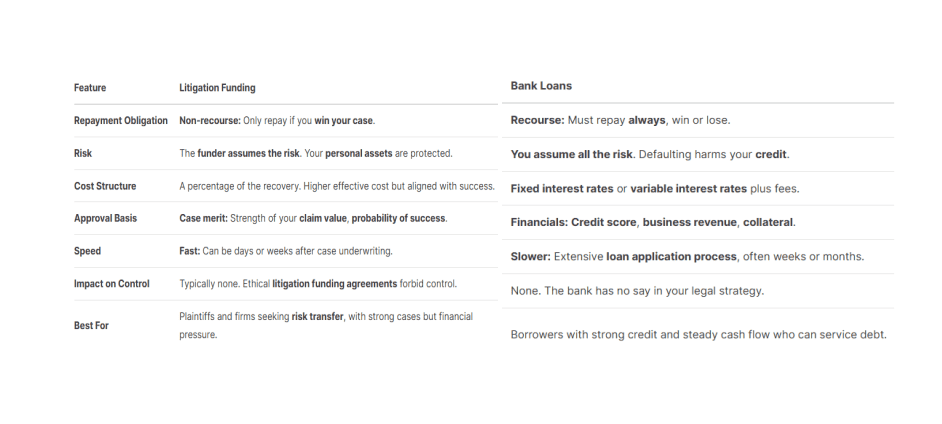
Deep Dive: The Pros and Cons
The Advantages and Disadvantages of Litigation Funding
Pros:
- Risk Mitigation: The #1 benefit. No win, no fee funding. You are shielded from the financial devastation of losing.
- No Monthly Payments: Improves cash flow management for businesses and law firms during lengthy disputes.
- Access Based on Case Strength: Your credit score or company's balance sheet is less important than the legal merit of your claim. Ideal for startups and SMEs.
- Levels the Playing Field: Provides the resources to fight deep-pocketed defendants in IP lawsuit, shareholder dispute, or antitrust cases.
Cons:
- Higher Effective Cost: If you win, the cost of capital is significantly higher than a traditional bank loan interest rate.
- Not for All Cases: Funders only invest in cases with a high minimum case value and a very strong probability of success.
- Regulatory Landscape: The regulation of litigation funding is evolving, with debates around disclosure to the court and ethics.
The Advantages and Disadvantages of Bank Loans
Pros:
- Lower Cost of Capital: If you have excellent credit, the interest rate on a lawsuit loan from a bank will be far cheaper than funding.
- Retain Full Recovery: You keep 100% of your settlement or judgment after repaying the fixed debt.
- Established Process: The loan application process is a well-understood system with clear regulations.
Cons:
- Personal and Financial Risk: You must repay the loan even if you lose your case, potentially leading to bankruptcy or business closure.
- Stringent Requirements: Requires a strong credit score for business loan, existing business assets, and a proven cash flow to meet debt service coverage ratio (DSCR).
- Monthly Payments: Adds immediate financial pressure from loan repayment schedules, which can strain your working capital.
Which Option Is Right For You? A Scenario-Based Guide
Choose Litigation Funding If:
- You cannot afford to lose and need non-recourse funding.
- Your case is strong but the defendant has deeper pockets ("David vs. Goliath").
- You have poor personal credit or your business lacks the collateral for a traditional loan.
- You are involved in high-cost, high-value disputes like patent litigation, commercial litigation, or class action funding.
- Your law firm needs capital investment to grow or finance a portfolio of cases on contingency.
Choose a Bank Loan If:
- You have an excellent personal/business credit score and strong financials.
- Your business has sufficient cash flow to handle monthly loan payments regardless of the case outcome.
- The cost of the lawsuit is predictable and you can secure a low-interest rate.
- You need to finance legal fees for a case you are very likely to win and can tolerate the risk of loss.
- You value a lower total cost of capital and prefer the structure of debt financing.
FAQs: Your Questions Answered
Q: Is litigation funding considered a loan?
A: No. It is a non-recourse cash advance against the future potential proceeds of your case. It is not debt on your balance sheet.
Q: Do I have to pay back litigation funding if I lose?
A: No. This is the critical difference. Repayment is contingent on success.
Q: What is the typical interest rate for a lawsuit loan?
A: Bank loans have annual interest rates based on the market and your credit (e.g., 6-15%). Litigation funding costs are not expressed as an annual rate but as a return on the funder's investment, which can be a multiple of the advance (e.g., 2-4x over several years).
Q: How long does it take to get funding?
A: Litigation funding can take a few weeks for due diligence. A bank loan can take a month or longer for approval and funding.
Q: Will the funder or bank control my case?
A: Reputable litigation funders and banks do not control litigation strategy. Decision-making remains with you and your attorney.
.
The Final Verdict: It’s About Risk and Reward
The choice between litigation funding and bank loans boils down to your appetite for risk and your financial standing.
- Litigation Funding is a powerful tool for risk transfer. It is capital without risk, designed for those who need to level the playing field and cannot afford the downside.
- Bank Loans are a cheaper form of debt financing for those who are financially secure and can confidently take on the obligation of repayment, win or lose.
Before deciding, compare lawsuit funding options and loan quotes carefully. Speak to a legal funding advisor and your financial advisor. Understand the total cost and the terms. Whether it's a non-recourse advance from a legal funder or a recourse loan from a bank, the right choice empowers you to pursue justice without compromising your financial future.
.
Top Litigation Funding Companies to Consider in 2025
If you've determined that non-recourse litigation funding is the right path for your commercial litigation or high-value claim, choosing the right partner is critical. The best litigation funding companies offer transparency, fair terms, and a streamlined process. Based on industry reputation, client reviews, and service offerings, here are five of the top lawsuit loan providers to consider in 2025:
Alliance Litigation Funding: Rapidly becoming a leader for both single-case and portfolio funding, Alliance Litigation Funding is renowned for its strategic approach to complex commercial disputes. They are a premier choice for businesses and law firms seeking capital to pursue meritorious claims in areas like breach of contract, shareholder disputes, and intellectual property litigation. Their team excels at crafting flexible funding solutions that align with their clients' goals.
Why they stand out: Known for their efficient due diligence process and competitive terms for strong cases.
Learn more about their services: Explore Alliance Litigation Funding's Solutions.
Or call at 609-314-0439
Remember: Always conduct your own due diligence. Compare litigation funding quotes and carefully review all terms within the litigation funding agreement before proceeding.



Funding Options
Company & Partners
Connect With Us
Follow Us on Social Media:
